

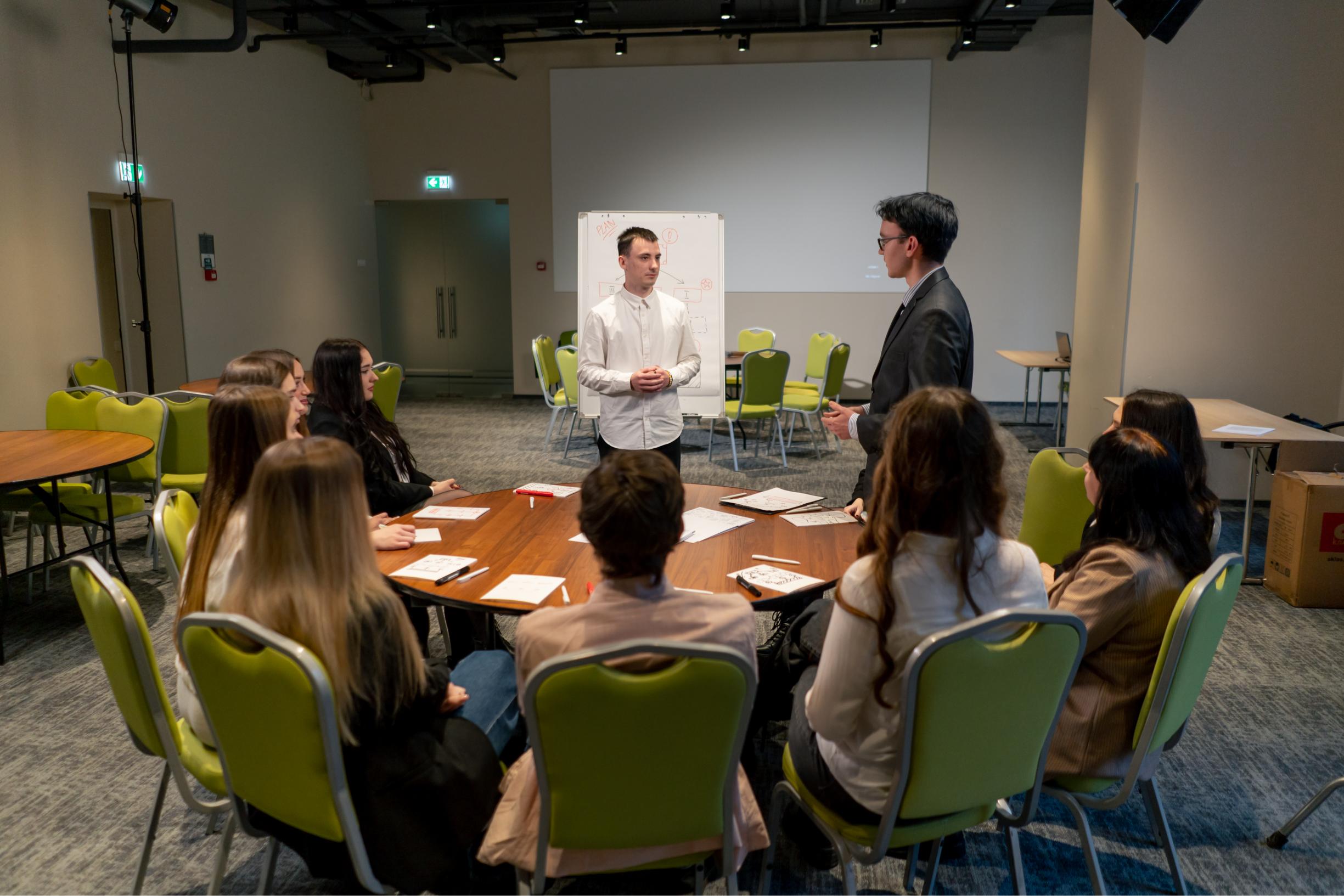
Organizing a workshop in Madrid without your own premises is perfectly feasible. Moreover, in many cases it's the smartest decision, especially for trainers who are just starting out, who work with varying groups, or who don't want the cost of space to dictate their decisions about when and how to deliver training.
The question isn't whether it can be done. The question is how to organize it well so that the workshop works, the attendees have an appropriate experience, and the numbers add up.
Why owning your own premises doesn't always make sense for a trainer
Owning your own premises has a logical appeal: total availability, customization of the space, and no dependence on third parties. But it also has a structural cost that many trainers initially underestimate.
A premises in Madrid involves a fixed monthly rent, an initial deposit, fit-out costs, utilities, insurance, and in many cases, investment in equipment. All of this must be paid both in the months when the workshop is full and in the months when there is no activity. For a trainer whose demand is irregular or seasonal, this fixed cost structure can become a burden that makes the business unviable precisely when it needs it most.
The alternative model, renting space only when needed, transforms a fixed cost into a variable cost directly tied to revenue. If there's no workshop, there's no space cost. If there is a workshop, the space cost becomes a predictable part of the total event cost that can be factored into the ticket price.
The first step: defining what type of space your workshop needs
Not all workshops need the same things, and choosing the right space starts with being clear about what features are essential for your specific one.
Capacity is the first criterion. How many people do you expect to have in each session? Not the theoretical maximum, but the realistic number you'll typically work with. A workshop for twelve people needs a very different space than one for thirty. And paying for capacity you won't use is an avoidable cost.
The required setup determines the type of space. A creative writing workshop needs large tables for individual work. A nonverbal communication workshop needs room to move around. A technical design or programming workshop requires each participant to have their own workstation with a connection. Identifying your required setup before looking for a space prevents you from booking something that won't work on the day of the event.
The required equipment is another filter. This includes a projector or screen to display content, an audio system if there is an audiovisual component, a whiteboard for visible collaborative work, or specific equipment for the type of workshop. equipped training spaces These items are included, but it's advisable to check exactly what is available and what needs to be brought.
Accessibility for attendees directly influences the actual attendance rate. A venue that is difficult to find or poorly communicated leads to late arrivals and conveys an image of disorganization that has nothing to do with the quality of the workshop content. Central location in Madrid, well connected It reduces these frictions.
How to calculate the price of the workshop including the cost of the space
One of the most common mistakes when organizing workshops without a dedicated venue is failing to properly factor the cost of the space into the ticket price. This leads to situations where the workshop is full, the attendees are satisfied, and yet the numbers don't add up.
The calculation is simple if done correctly. The total cost of the space (hourly rental plus any additional services) is divided by the minimum number of attendees required to make the workshop profitable. The result is the cost of the space per attendee, which is added to the other costs to calculate the minimum viable price.
For example, if the classroom rental costs 80 euros for a four-hour session and the workshop has a minimum of ten participants, the cost of the space per participant is 8 euros. Other costs (preparation, materials, administration) and the desired profit margin are then added to this amount to arrive at the final price.
This calculation has an important implication: the price of a workshop in a quality venue doesn't have to be significantly higher than one in a mediocre venue, provided there are enough participants. And a quality venue allows for a higher price because it reinforces the perceived value.
The step-by-step organization process
Organizing a workshop without your own premises has a logical sequence that, if respected, avoids the most common problems.
The first step is to define the content and format of the workshop clearly enough to determine what space is needed. Not the other way around. Many trainers start looking for a space before they're clear on what they're going to do there, and that leads to adapting the workshop to the space instead of choosing the space for the workshop.
The second step is to estimate the realistic capacity. Not the maximum the space can hold, but the number of attendees with which the workshop makes sense both as an experience and as a business. For participatory workshops, groups of 10 to 20 people usually work better than larger groups. For more lecture-based workshops, the number can increase without compromising quality.
The third step is to identify two or three spaces that meet the requirements and compare not only price but also location, included equipment, booking flexibility, and cancellation conditions. Rent a classroom in Madrid By the hour, you can adjust the exact duration needed, including preparation and cleanup time.
The fourth step is to open registration before confirming the venue reservation, or at least simultaneously. Confirming the venue before knowing if there is sufficient demand locks up money in a reservation that may not make sense if the workshop doesn't fill up. Opening registration with a tentative date and confirming the venue when a minimum number of participants is reached is common practice among experienced trainers.
The fifth step is communicating with registered participants well in advance. Clear instructions on how to get there, what to bring, and what to expect from the workshop reduces uncertainty for attendees and the number of last-minute questions that waste the organizer's time.
What the attendees expect, even if they don't say so
Workshop participants rarely make explicit comments about the space if it's functioning well. They simply enjoy the workshop. But if the space is lacking, they do mention it, both in subsequent conversations and in reviews or recommendations.
What they expect, even if they don't articulate it, is consistency between the price they've paid and the experience they receive. If the workshop has a premium price, the space should reflect that. If the price is affordable, the space should at least be adequate and functional.
The correct temperature in the room seems like a minor detail until it becomes the main topic of conversation during breaks because it's too hot or too cold. The projection system malfunctioning at the start creates tension that takes several minutes to dissipate. And the constant background noise filtering in from other parts of the building erodes concentration cumulatively over the course of the day.
Anticipating these factors when choosing the space is part of the organizational work that attendees don't see but perceive in the quality of their experience.
Tools for managing registrations and payments
Organizing a workshop without your own premises also means managing registrations and payments without the infrastructure of an established academy or training center. There are accessible tools that simplify this process.
Ticketing platforms like Eventbrite allow you to create the event, manage registrations, and collect ticket prices with a transaction fee, without a fixed cost. For occasional workshops with few attendees, this model is more efficient than setting up your own payment gateway.
For trainers with a regular volume of workshops, more comprehensive training management platforms allow for centralizing registrations, sending communications, managing materials, and collecting payments in one place. The investment in these tools is recouped through time saved in management.
Receiving advance payment for entry is a recommended practice to more securely reserve your space. A registered participant who has paid is much less likely to fail to show up on the day of the workshop than someone who has only RSVP'd. This also allows for a more accurate estimate of the actual capacity in advance.
Scaling up the model: from one-off workshop to training program
The hourly space rental model isn't just for one-off workshops. It's also the structure upon which many trainers build regular training programs that eventually become their main activity.
A successful monthly workshop can become a bi-weekly one. A three-session program can be expanded to five or six. And in that process, the volume of space usage grows to the point where it may make sense to explore models with a greater commitment but a better hourly rate, such as hourly packages or recurring usage agreements with the space.
The Multipurpose rooms available in Chamberí They allow this type of scaling within the same space, maintaining the continuity of location that regular attendees value.
For trainers who, in addition to space, need support in legal or tax aspects of their activity as freelancers or as small training companies, the integrated services ecosystem Some spaces can add value beyond the square meter.
To check classroom availability and rental conditions for workshops, ILCOWORKING is located at Glorieta de Bilbao nº 1, 3rd floor, right, Madrid, accessible by Bilbao metro lines 1 and 4. Opening hours are 8:00 a.m. to 8:30 p.m., Monday to Friday. Contact: info@ilcoworking.es, 91 117 94 82, or 900 264 918.

