

The empty office is no longer a perception problem, it's a management problem
There's a scene that repeats itself in thousands of Spanish companies every week: on a Tuesday at ten in the morning, half the workstations are empty. Not because there's a staff shortage, but because part of the team is working from home. On Wednesday, occupancy rises to seventy percent. On Thursday, it drops again. And on Friday, it's practically a desert, with fluorescent lights on but no one in sight.
That traditional office, designed to accommodate the entire staff simultaneously, has become one of the most difficult expenses for any finance director to justify. According to data from the INE (National Institute of Statistics) and various studies of the corporate real estate sector, The average office space in Madrid has a real occupancy rate of less than 60 % in companies that have adopted some form of teleworking. That is to say: four out of ten positions are being paid for without being used.
The problem isn't remote work itself. The problem is that many organizations have adopted it without adjusting their infrastructure. They continue to pay rent for a twenty-person office when, in practice, no more than twelve people are ever in the office at the same time. And that, in a city like Madrid, where office space in central areas can cost over €20-25 per square meter per month, has a direct impact on the bottom line. (If you want to see the full breakdown of what it really costs to maintain a traditional office, we analyze it invoice by invoice in our article on...) real costs of a traditional office versus a coworking space.)
This article is a practical, step-by-step guide for human resources directors, CEOs, and operations managers who want to take the final step: abandon the oversized office and transition to a hybrid model supported by flexible spaces, without losing team cohesion or corporate identity.
What is the hybrid flex model and how does it differ from "letting people work from home"?«
The hybrid model is not simply about allowing people to work from home some days. That's the most superficial version, and the one that creates the most problems. hybrid flex model It is a comprehensive strategy that combines three elements:
- Planned in-person attendance, It's not improvised. The days spent in the office are based on a functional criterion: team meetings, collaborative work sessions, training, or in-person customer service.
- Space adapted to the actual demand, No to the theoretical organizational chart. Instead of a fixed position per person, the company rents the space it needs according to its occupancy pattern.
- Tools and culture that support coordination, both in-person and remote. Without this, the model breaks down within a few weeks.
The shift towards this model is not a passing fad. Royal Decree-Law 28/2020, on remote work, and its subsequent regulatory development, consolidated a legal framework that obliges companies to formalize teleworking agreements. But the law regulates the right; the organization of the physical workspace is left to each company. And that is where most fall short.
How to implement the transition: three concrete steps
Transitioning from a traditional office to a hybrid model based on flexible workspaces isn't something that happens overnight. It requires analysis, structural decisions, and an internal communication plan. These are the three fundamental steps.
Step 1: Audit of space usage and effective presence
Before making any decisions about square meters, you need to answer a simple question with data: How many people are actually in the office each day?
The most direct way is to track this for four to six weeks. Simply record daily how many workstations are occupied, which meeting rooms are used, and during which times activity is concentrated.
The key indicators of this audit are:
- Average daily occupancy (by day of the week).
- Peak simultaneous occupancy (the day with the most people at once).
- Actual use of meeting rooms versus reserves.
- Cost per position actually used (total rent divided by actually occupied positions, not by contracted positions).
This last piece of data is usually the most revealing. If a company pays €4,000 per month for a fifteen-station office, but the average occupancy is eight people, the real cost per station is closer to €500 than the theoretical €267. With that figure in hand, the conversation changes.
Step 2: Size the space — office for the nuclear team, flexible workstations for peak periods
Once the audit is complete, the strategic decision is what type of space is being rented and with what configuration. There is no single recipe, but there is a principle that works for most companies in transition:
Size the fixed space for the nuclear equipment and cover peak attendance with flexible workstations.
In practice, this translates into a combined model:
- A private office The office space is tailored to the number of people who come to the office daily (management team, administrative staff, and those with constant physical presence). This office serves as the base of operations: the company's visual identity, physical archives, and a central point of reference.
- Coworking spaces available by the day or in monthly packages. for rotating team members. If twelve people are present on Tuesday but only six on Thursday, it doesn't make sense to pay for twelve permanent, fixed positions. The systems of job rotation With prior booking, they resolve this efficiently. (If you need to fully understand the differences between a fixed and a flexible position before deciding, we explain it in detail in our article on fixed or flexible workstation in coworking.)
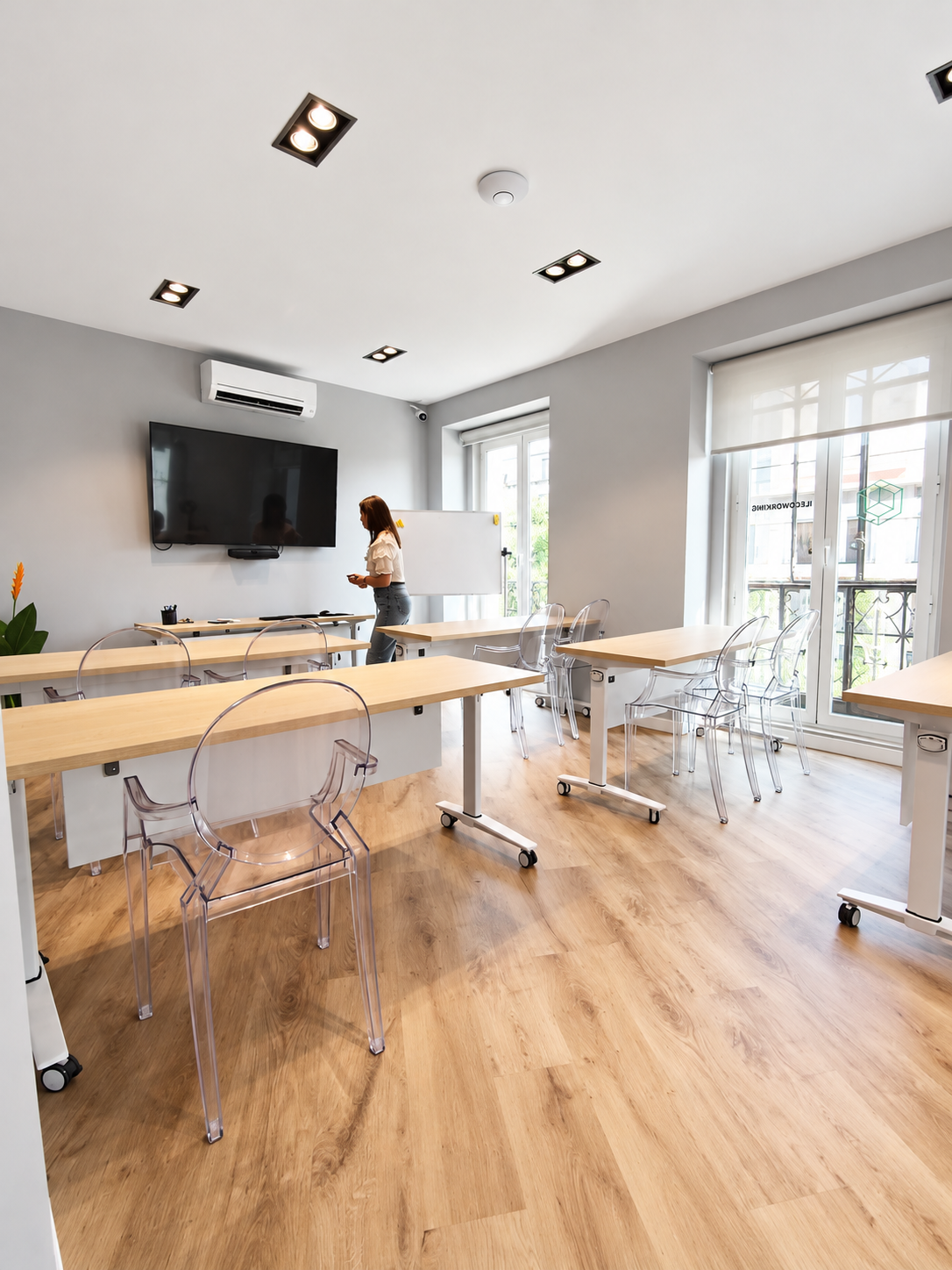
- Access to multipurpose meeting rooms Available by reservation for full team meetings, internal training sessions, or client sessions.
This combined model is precisely what professional coworking spaces offer. At ILCOWORKING & LEGAL SERVICES, for example, companies can combine private offices of varying sizes with flexible workstation packages and access to rooms equipped with videoconferencing technology. Typical prices for spaces of this caliber in central Madrid range from €250 to €500 per month for a dedicated workstation, and from €15 to €30 per day for hot desk access, although these vary depending on included services and commitment periods.
The advantage is that space ceases to be a fixed cost and becomes a variable that is adjusted quarterly according to the actual needs of the team.
Step 3: Managing team culture in the new model
The most common fear among managers considering this change is the loss of corporate culture. If people don't meet in the same space every day, will the sense of belonging diminish?
The answer: only if it is not actively managed. A well-implemented hybrid model can strengthen corporate culture, because it forces you to be intentional about the moments of encounter instead of relying on forced cohabitation to spontaneously generate bonds.
Some practices that work:
- Establish mandatory matching days For the whole team (for example, Tuesdays and Thursdays), dedicated to collaborative work and follow-up meetings. The other days are for individual work, where each person chooses whether to come to the office or work remotely.
- Design in-person days for interaction, not for individual concentration. If office days are designed for collaboration, the space should reflect that: large tables for teamwork, informal areas for quick chats, and multipurpose rooms for workshops. Concentrated work is best done from home, and that's perfectly fine.
- Use asynchronous communication tools To keep the team connected on remote days, shared boards, centralized documentation, and brief video conference check-ins prevent remote days from becoming islands of isolation.
- Leveraging the flexible space ecosystem. A professional coworking space offers natural contact with other professionals and a dynamic environment that conveys modernity and openness. Employees who work in these spaces tend to value the experience positively, which contributes to... talent retention.
What the employee gains: location, work-life balance, and professional environment
The transition to the hybrid model not only benefits the company's bottom line. The location and flexibility of the new space have a direct impact on the team's quality of life. A center like ILCOWORKING & LEGAL SERVICES, located in the Glorieta de Bilbao (Chamberí district), offers unbeatable connectivity—Metro lines 1, 4, and 10, dozens of bus lines, and BiciMAD bike-sharing—and a neighborhood with everything needed for a full workday, from restaurants to green spaces. It's not the same as going to an industrial park on the outskirts; you can walk there from Malasaña, Trafalgar, or Alonso Martínez.
Regarding the conciliation, The hybrid model in flexible workspaces allows each person to organize their week according to their actual needs: concentrating in-person work in the mornings that best suit them, completing hours from home when personal circumstances require it, and reserving a desk only on the days it is truly needed. According to data from Randstad and the Flexible Work Observatory, more than 70% of Spanish workers value flexible hours and location as one of the three most important factors when choosing or remaining with a company.
Complementary services: more than just a space
In addition to the operational infrastructure—ergonomic furniture, high-speed internet, security, cleaning, professional reception, and registered business address—at ILCOWORKING & LEGAL SERVICES, members of the space have the opportunity to additionally contract legal, tax and accounting advisory services through Acountax, under preferential conditions. This is a complementary service, independent of the workspace fee, which allows you to centralize the administrative management of your business without leaving the center.
For an SME that is resizing its structure, having the workspace and access to professional advice under the same roof greatly simplifies daily operations, although it is important to be clear that these are services with their own pricing.
Take the plunge: design a tailor-made plan for your team
Transitioning to a hybrid model doesn't have to be a leap of faith. The most common approach is to do it gradually: start with a trial period of three to six months, measure actual occupancy, adjust the space configuration, and consolidate the model once the data confirms it works.
The first concrete step is to speak with a team that understands the needs of companies in transition and can design a tailored solution. At ILCOWORKING & LEGAL SERVICES, the team advises each company individually: analyzing team size, attendance patterns, required services, and available budget to propose a combination of private office space, flexible workstations, and meeting room access that perfectly matches the company's specific needs.
Request a free consultation and discover how to adapt your workspace to the real pace of your company. You can visit us at Glorieta de Bilbao, in Chamberí, or contact us for more information. Schedule a guided tour

