

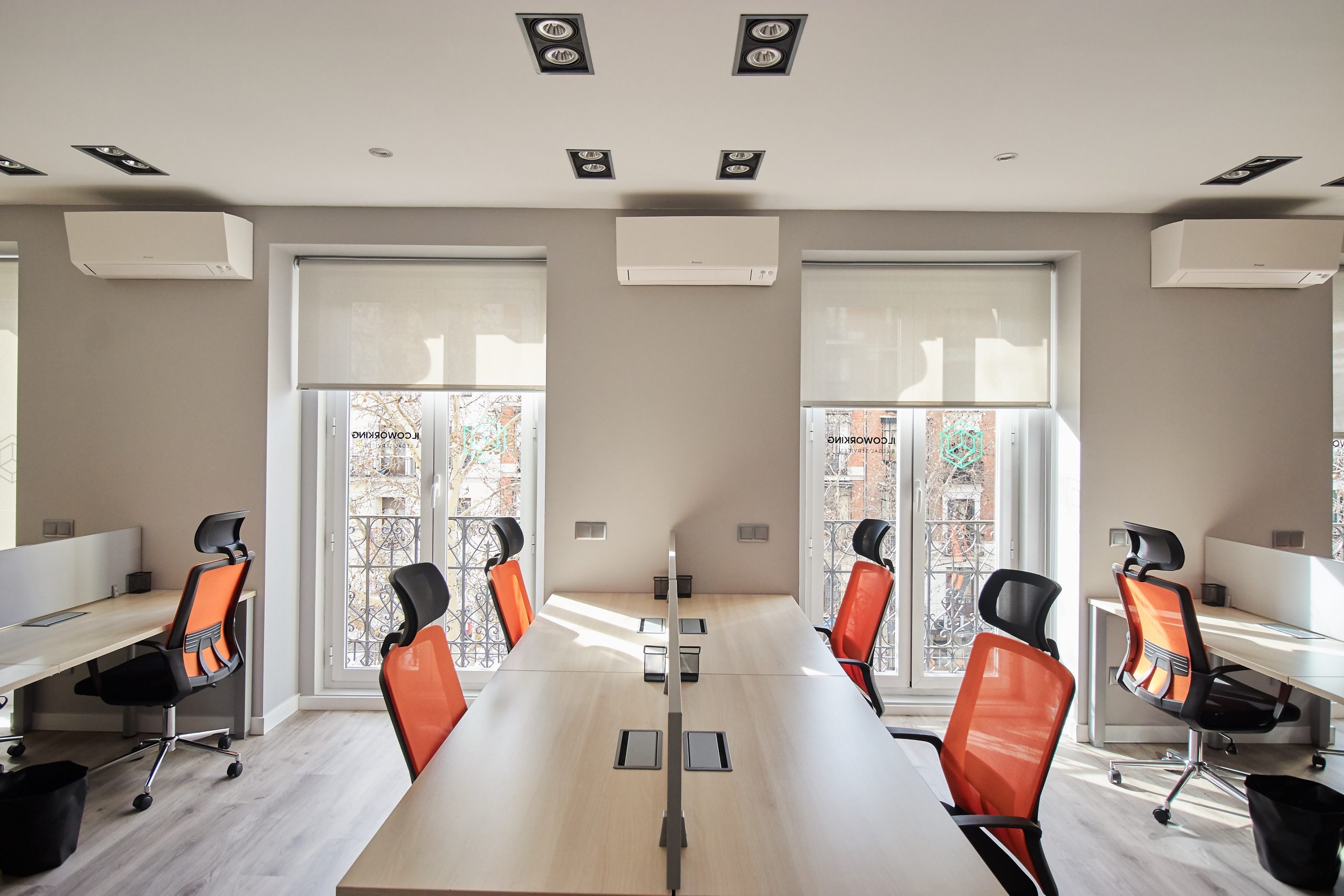
Classroom rental in Madrid has become an increasingly popular solution for academies, independent trainers, and education professionals. Instead of taking on the costs and commitments of owning their own premises, more and more professionals are opting for flexible spaces that adapt to their specific needs.
In this comprehensive guide, we explain everything you need to know about renting classrooms in Madrid: what types of spaces exist, what uses they are ideal for, what a professional classroom should include, how to choose the right location, and what aspects to consider before making a decision.
Why rent classrooms instead of having your own premises?
Absolute flexibility to adapt to your activity
Classroom rental allows you to reserve space only when you actually need it. If you're teaching an intensive weekend course, you can rent a classroom for two days. If you teach regular classes on Tuesday and Thursday afternoons, you only reserve those time slots. You don't pay for time you don't use.
This flexibility is especially valuable for trainers who are just starting out, academies with variable demand depending on the time of year, or professionals who provide training occasionally in addition to their main activity.
No maintenance or management costs
When you rent a classroom, you completely forget about managing the space. You don't have to hire cleaning services, deal with air conditioning breakdowns, replace outdated technological equipment, or deal with neighbors and government agencies.
The rental center takes care of everything: climate control, internet connectivity, audiovisual equipment, well-maintained furniture, and cleaning after each use. All you have to do is arrive, teach your class, and leave.
Access to strategic locations
Offering classes in well-connected areas of Madrid is essential for attracting students and facilitating their attendance. Renting classrooms allows you to have a presence in neighborhoods like Chamberí, Centro, Moncloa, or Arganzuela without having to bear the full cost of commercial rent in these locations.
You can even rotate between different areas depending on where your target audience lives at any given time, or teach the same course in several neighborhoods to make it easier for students from different parts of the city to access it.
Growth without structural changes
Your educational project can evolve without you having to move or renegotiate complex contracts. If you start with groups of 8 students and in six months you have groups of 20, you simply move to a larger classroom. If you need to teach two classes simultaneously, you reserve two classrooms in the same center.
This scalability allows you to grow organically, without abrupt movements or advance investments that may not materialize.
Types of classrooms for rent in Madrid and their ideal uses
White classrooms: the quintessential multipurpose space
White classrooms are open-plan spaces with modular furniture, a projector, a whiteboard, and internet connectivity, but without permanent computer equipment. They are the most versatile and in highest demand.
What they are ideal for:
Preparation for competitive examinations. Candidates need quiet, well-lit spaces, large tables for laying out study materials and notes, and a whiteboard for the teacher to explain complex concepts. White classrooms provide the necessary atmosphere for intense study and review sessions, conducive to concentration.
Language classes. The flexible furniture arrangement allows for different configurations depending on the methodology: a circle for conversation, rows for grammar, or small groups for role-plays.
Business training and professional development. Courses on team management, leadership skills, corporate communication, marketing or human resources benefit from neutral and professional spaces.
Healthcare training and compliance. Refresher courses on protocols, occupational risk prevention, data protection or sector regulations.
Computer classrooms: when technology takes center stage
These classrooms are equipped with an individual computer for each student, robust connectivity, and pre-installed software. They are essential when each participant needs to practice on a computer.
What they are ideal for:
Training in professional office automation. Advanced Excel courses, corporate Word, PowerPoint for impactful presentations, or complete Microsoft Office packages.
Programming and development. Programming bootcamps, Python courses, web development, databases, or any language where each student needs to write and compile code.
Graphic design and digital creativity. Training in Adobe Photoshop, Illustrator, InDesign, video editing or 3D design that require powerful computers and quality monitors.
Accounting and administrative management. Courses with specific software such as ContaPlus, electronic invoicing applications, payroll management or business ERPs.
Digital marketing and AutoCAD. From Google Analytics and online advertising campaigns to technical design and architecture that require specialized software.
Classrooms for exam preparation academies: the space for intensive study
Exam preparation academies have very specific needs that go beyond a standard classroom. Candidates spend many consecutive hours studying and need an environment that fosters maximum concentration.
Essential features:
Ergonomics for long days. Candidates study between 4 and 8 hours a day. They need chairs with adjustable lumbar support, large individual desks that can accommodate the entire syllabus laid out, a laptop, a notepad, and coffee without feeling cramped.
Lighting without eye strain. Adjustable LED lighting, without reflections on notes or laptop screens, with a neutral color temperature that does not tire the eyes during marathon days.
External noise control. Superior sound insulation compared to conventional classrooms. Candidates need absolute concentration without traffic noise, nearby construction, or conversations from adjacent classrooms.
Stable temperature. The air conditioning should maintain a constant temperature between 21 and 23 degrees throughout the day, without sudden changes that distract or cause discomfort.
Separate rest areas. A separate area where students can take breaks, have coffee and chat briefly without disturbing those who are still studying in the classroom.
What they are ideal for:
Preparation for competitive examinations. Justice (judge, prosecutor, court clerk), education (primary school teachers), security forces (National Police, Civil Guard), healthcare (nurses, specialist doctors), and administration (state administrator, tax inspectors). All require intensive study for months.
Rooms for workshops and experiential training: when movement is part of learning
These spaces are open-plan, without fixed tables, with flooring suitable for standing for hours and fully modular furniture that can be rearranged or completely removed.
What they are ideal for:
Coaching and personal development. Workshops on emotional intelligence, stress management, leadership or neurolinguistic programming with standing and movement activities.
Public speaking and communication. Courses in public speaking, presentations, storytelling or theater applied to business where students practice speeches and simulate real presentations.
experiential corporate training. Team building, cohesion dynamics, conflict resolution or creativity and innovation workshops with agile methodologies or design thinking that require clear space and freedom of movement.
What a professional classroom should include: a checklist for trainers
Functional audiovisual equipment
A professional classroom should have a projector or high-definition screen, HDMI and wireless connectivity, and a large (at least 1.5 meters) whiteboard in good condition with working markers. Some classrooms have an interactive whiteboard, useful for technical training where the instructor needs to write on projected documents.
Ergonomic and adaptable furniture
Chairs should have lumbar support, a padded seat, and adjustable height. For training sessions longer than two hours, ergonomics are essential. Tables should be large enough to comfortably accommodate a laptop, notebook, water bottle, and plenty of free space.
The layout should be adaptable: rows for lectures, a U-shaped arrangement for debate, or groups of 4-6 people in islands for collaborative work.
Robust connectivity
The Wi-Fi must support 20-30 people browsing simultaneously without slowdowns. A slow connection will ruin training sessions that rely on digital resources. There must be enough accessible power outlets for students to plug in their laptops, mobile phones, and other devices.
Air conditioning, lighting and soundproofing
The temperature should be kept stable (21-23°C) throughout the session with adequate ventilation. The lighting should be adjustable, glare-free, and bright enough for reading without straining the eyes.
Soundproofing should prevent students from hearing conversations in adjacent classrooms, traffic noise from outside, or other activities in the building. Auditory distractions constantly disrupt the flow of the lesson.
How to choose the ideal location for your classroom in Madrid
Accessibility in public transport
The location of your classroom will largely determine who can attend your training sessions. Students especially value the ease of access without needing a car.
Proximity to the Metro. The best classrooms are less than a 5-minute walk from a Metro station, ideally on central lines that connect to the entire city. Lines like 1, 4, 5, 6, or 10 are well-served and connect to major transport hubs.
Access by bus. Complementing the Metro with several bus lines multiplies the potential audience. Areas with 4-5 different bus lines allow access from virtually anywhere in Madrid.
Renfe commuter trains. If part of your target audience lives in the Madrid metropolitan area (Alcalá, Móstoles, Getafe, Las Rozas), proximity to commuter rail stations significantly expands your reach.
Top areas for training in Madrid
Chamberí: professionalism and connectivity. A residential and professional neighborhood with excellent metro (lines 1, 4, 5, and 10) and bus connections. A quiet environment ideal for studies requiring concentration, less crowded than the city center but equally accessible. Plenty of cafes and restaurants for students.
City center (Sol, Gran Vía): maximum accessibility. Connects to all Metro and commuter rail lines. Ideal for corporate training where participants come from nearby offices or for short courses where attendees make a one-time travel effort.
Moncloa: university area. Multi-line interchange, university atmosphere. Works very well for training aimed at young people, students or recent graduates.
New Ministries and Arganzuela. Nuevos Ministerios is an ideal corporate hub for B2B training. Arganzuela offers good transport links to southern areas of Madrid in a quieter environment.
Proximity to complementary services
Students appreciate having places to eat nearby (especially set menus for €8-12 for full-day courses), cafes for breaks, banks, and basic restrooms. If your course involves heavy equipment, proximity to lockers or storage is a plus.
Key factors before renting a classroom
Clearly define your need
How many students usually? Don't book based on the theoretical maximum, but on the actual average. If you expect 12-18 students, a 20-seat classroom is suitable.
How often? Occasional (monthly), regular (2-3 times/week) or intensive (daily) use will determine which model suits you best.
Session duration? Classes of 2 hours vs 6-8 hours have very different ergonomic and comfort requirements.
What equipment is needed? Pay only for what you're going to use: preparing for competitive exams requires a whiteboard and projector, but not computers. An Excel course does.
Visit the classroom before you commit
Never book long-term without a personal visit. During the visit:
Detects ambient noise. Stay silent for 5-10 minutes to detect outside traffic, conversations from adjacent spaces, or air conditioning noise.
Check actual equipment. Turn on the projector, test WiFi with your mobile phone, sit in several chairs, write on the whiteboard.
Observe maintenance. Stains on walls, deteriorated furniture, or noisy air conditioning indicate problems that will affect your experience.
Confirm time availability. If your preferred time is Tuesdays and Thursdays 6-9pm, please confirm that you can book it on a recurring basis.
Compare several options
Visit at least 2-3 centers in similar locations. Make a list of priorities: is location, equipment, comfort, or flexibility more important? Ask other trainers about their experience.
Frequently asked questions about classroom rental in Madrid
Can I try the classroom before making a long-term commitment?
Yes, most centers allow you to reserve a classroom by the hour so you can try out the space before signing a monthly contract. Take advantage of this option to teach a real class, check that everything works correctly, and identify any problems you missed during your visit.
Some centers offer discounts on your first booking to make this trial easier. It's a worthwhile investment: it's better to pay for a trial session than to discover serious problems after committing to a three-month contract.
What classroom capacity do I need based on my number of students?
As a general rule, book a classroom with a capacity of 20-30 seats, which is higher than your average number of students. If you expect 15 participants, a classroom with 18-20 seats is suitable. This allows you to accommodate any last-minute extra students without feeling overwhelmed by space.
For classrooms where students use their own laptops, you need more space per person than in classrooms focused solely on theory. Allow approximately 2-2.5 square meters per student for technology-based training, compared to 1.5-2 square meters for purely theoretical classes.
Can I personalize the classroom with my own materials?
It depends on the venue and the type of contract. With hourly rentals, you usually can't permanently modify the space. You can, however, bring posters or materials that you put up and take down after each session.
For monthly contracts with exclusive use of a classroom, many centers allow some customization: hanging informational posters, adding mobile shelves with teaching materials, or even displaying your corporate logo. Everything you install must be reversible, and you must leave the space in its original state at the end of the contract.
What do I do if the equipment fails during my class?
Professional centers must have technical support available during operating hours. Before hiring them, ask about their response time for technical issues: 5 minutes, 30 minutes, the next day?
For hourly rentals, a serious technical issue that prevents the class from taking place should result in the session not being charged or an alternative classroom of similar characteristics being provided. Clarify this policy before booking.
As a safety measure, always carry a backup portable projector if your training relies heavily on projecting content. It's a small investment that prevents disasters.
Are the classrooms available on weekends and holidays?
Many classroom rental centers are open on Saturdays, and some are also open on Sundays. Holidays vary by center: some are open, others are closed.
If your training model requires teaching classes on weekends (very common in employee training), explicitly verify this availability before committing.
Can I record my class on video?
Most centers allow recordings for your own educational use: record your class to share it later with absent students, create training content, or improve your teaching technique.
What is usually prohibited is the commercial use of these recordings (selling courses recorded in your space) without express authorization, or publishing images of the space for advertising purposes without permission from the center.
Inform your students if you will be recording the sessions to comply with data protection regulations. They must consent to having their image and voice recorded.
Conclusion: The right classroom enhances your educational project
Renting classrooms in Madrid offers flexibility, professionalism, and strategic locations without the burdens of owning your own premises. The key is to clearly define your needs, visit several spaces to compare, and choose based on your target audience and training model.
A well-equipped classroom, in a good location and with adequate support, is not just a space to teach classes: it is a tool that enhances learning, improves the experience of your students and facilitates your work as a trainer.
Take the time to choose wisely. The difference between a suitable classroom and a mediocre space can determine the success or failure of your educational project.

