

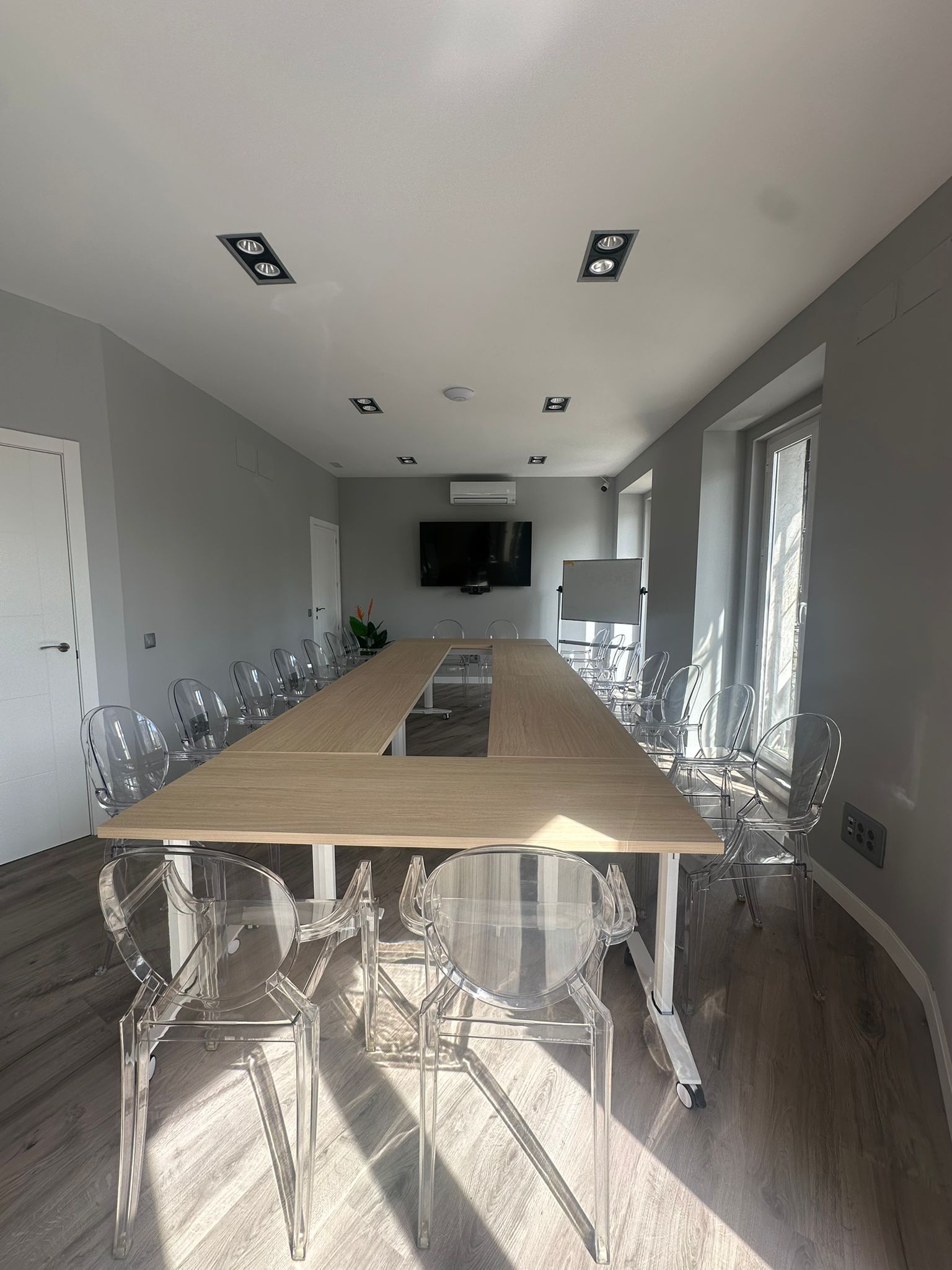
The private tutoring model has evolved considerably in recent years. What was once limited to individual sessions at the teacher's or student's home has now transformed into a group format that allows teaching professionals to optimize their time and increase their income without sacrificing service quality.
This shift has created a new need: professional spaces for teaching these group classes. Renting classrooms in Madrid has become the preferred solution for independent teachers, small academies, and specialized trainers seeking flexibility without the fixed costs of owning their own premises.
Why private tutors are choosing rented classrooms
The decision to rent a classroom instead of using other spaces has very specific reasons that go beyond simply saving money.
Teaching from home may seem convenient at first, but it has significant limitations. The lack of separation between personal and professional life, space constraints as the group grows, and the less professional image it projects to students are factors that many teachers find problematic. Furthermore, depending on the type of neighborhood, there may be restrictions or complaints about the constant flow of people.
Public libraries and cafes, while free or low-cost, aren't ideal either. Ambient noise makes it difficult to concentrate, there's no guarantee of space availability, and the lack of privacy can be a problem for certain types of teaching. Trying to explain complex math concepts or practice conversational English in a crowded Starbucks rarely works well.
Renting an entire premises on a long-term contract involves a significant financial commitment. Deposits, community fees, utilities, insurance, and the inability to adapt the space to changing needs mean this option only makes sense when you already have a very stable and predictable number of students.
Flexible classroom rental offers a perfect middle ground. It allows access to professional spaces by paying only for the hours used, without long-term commitments, with equipment already included, and with the ability to scale up or down as demand evolves.
Types of group classes that work best in rented classrooms
Not all private lessons lend themselves equally well to the group classroom format, but there are several types that have proven to work particularly well.
Language classes are probably the most common use case. Groups of four to eight people allow for conversation practice, role-playing, and listening comprehension exercises in a much more dynamic way than individual sessions. Students benefit from listening to other classmates, learning from others' mistakes, and practicing in an environment that better simulates real-life communication situations.
Group tutoring has gained considerable popularity, especially in the lead-up to exams. Small groups of students in the same grade who share difficulties in subjects like math, physics, or chemistry can work together on similar problems, share study strategies, and benefit from the teacher's explanations of each other's questions.
Exam and competitive exam preparation is another area where the group format offers significant value. The pressure and motivation of the group, the opportunity to conduct mock exams under realistic conditions, and the exchange of study techniques among candidates have led many tutors to adopt this model.
Creative and hands-on workshops also work exceptionally well. From creative writing classes to programming workshops, and from graphic design sessions to digital marketing, these formats benefit enormously from having a suitable space with large tables, good lighting, and the ability to use a projector to show examples.
Ideal classroom setup for group private lessons
The physical space directly influences the quality of teaching and the students' learning experience. It's not just about having tables and chairs, but about ensuring that the layout and equipment foster interaction and concentration.
For small groups of four to eight people, a U-shaped or round-table configuration is usually the most effective. It allows all participants to see each other, facilitates participation, and gives the teacher the flexibility to approach each student when they need individual attention. This arrangement works particularly well for language classes and participatory workshops.
When the group is somewhat larger, from eight to twelve people, a traditional classroom setup with rows can be more practical, especially if the projector or whiteboard will be used frequently. The important thing is that the rows aren't too deep to maintain a sense of closeness and allow the teacher to move among the students.
For hands-on workshops where students work on their own devices or materials, individual or paired tables offer the necessary space without feeling crowded. This is especially relevant for programming, design, or any activity that requires individual concentration interspersed with group discussion sessions.
Essential equipment includes a good whiteboard or, ideally, an interactive whiteboard that allows you to save what you've written and share it with students later. A projector or large screen is crucial for showing presentations, explanatory videos, or correcting exercises so that everyone can see it clearly.
High-quality Wi-Fi connectivity is essential in 2026. Virtually all classes, even the most traditional ones, incorporate online resources, internet searches, or require students to access digital platforms at some point. A slow or intermittent connection completely disrupts the flow of the class.
Lighting is an often underestimated factor that greatly affects concentration. Natural light is ideal, provided it can be regulated to avoid glare on the projector screen. Artificial lighting should be sufficient but not excessive, and preferably dimmable.
The acoustics of a space matter more than you might think. A classroom with a lot of echo makes it difficult to understand, especially in language classes. Sound-absorbing materials on walls and ceilings, or simply curtains and carpets, can make a big difference.
How to organize your group class schedule
Time management is one of the biggest challenges when transitioning from individual to group classes in a rented space. The key is to group sessions intelligently to optimize rental costs.
Many teachers begin by booking blocks of two or three consecutive hours to teach several group classes. For example, an English teacher might book a classroom on Tuesdays and Thursdays from 5:00 to 8:00 PM, teaching three one-hour classes to different groups of beginner, intermediate, and advanced students. This allows them to better utilize the cost of the space and reduce travel time.
Another effective strategy is to combine classes on different subjects on the same day if they are compatible. A trainer who teaches both Cambridge exam preparation and Business English could occupy the classroom for an entire afternoon, alternating groups according to each group's needs.
For small academies or teachers with several collaborators, sharing the cost of renting a classroom can be very efficient. If two teachers who don't compete with each other (for example, one teaching languages and the other providing academic support) coordinate their schedules, they can split the monthly cost and have access to the space at different times.
The seasonality of demand must also be taken into account. September, January, and March are typically peak months for tutoring, while June and July focus more on intensive exam preparation or summer courses. Adapting the number of hours rented to these peak periods allows for optimizing the investment.
Legal and administrative aspects to consider
Giving private group lessons professionally involves fulfilling certain administrative obligations that should be clear from the beginning.
If the classes are held regularly and generate consistent income, registering as self-employed is the best option. The activity can be classified under different IAE (Economic Activities Tax) codes depending on the specialization: language teaching, supplementary academic training, or non-formal educational activities. This allows you to issue invoices correctly and deduct expenses related to the activity, including classroom rental.
The registered business address doesn't necessarily have to be the same as the location where the classes are held. Many teachers maintain their registered business address at home and simply rent classrooms when needed. However, for those who want to project a more professional image, some business centers and coworking spaces offer registered business address services that allow them to use their business address.
Regarding liability insurance, while not mandatory in all cases, it is highly recommended. A student injury during class, or accidental damage to the rented classroom equipment, can lead to significant problems without adequate coverage.
Data protection is also relevant when working with groups. If you collect students' personal data (names, emails, phone numbers) to manage classes, send materials, or communicate with them, this technically constitutes personal data processing that must comply with the GDPR. This doesn't necessarily mean following complex procedures, but it does mean providing adequate information about what data is being collected and for what purpose.
Strategies for filling your group classes
Having a professional space to teach classes is only part of the equation. The other, equally important part is getting enough students to fill those classes and make the investment in renting the classroom worthwhile.
Digital marketing is practically essential these days. A basic presence on Google, with a well-optimized Google My Business profile, can generate organic leads when people search for classes in your specialty and area. Including keywords like "group classes," "small groups," or "Madrid city center" helps you appear in relevant searches.
Social media works particularly well for certain types of training. Instagram is effective for creative workshops or activities where visual results of student work can be showcased. LinkedIn works best for professional training or preparation for technical certifications. The key is to show the classroom environment, share testimonials from satisfied students, and demonstrate concrete results.
Word of mouth remains the most powerful recruitment channel for private lessons. Offering a free or discounted trial lesson to current students so they can bring a friend can accelerate group growth. Many teachers have filled their classes simply by asking satisfied students to share their experience with acquaintances who might be interested.
Collaborating with other complementary professionals also creates opportunities. An English teacher could collaborate with a computer academy to offer technical English courses for programmers. A civil service exam preparation tutor could partner with a specialized bookstore that recommends their classes to study material buyers.
Online tutoring platforms like Tusclasesparticulares, Classgap, or Superprof can serve as an initial lead generation channel, although it's important to keep in mind that they charge commissions. A possible strategy could be to use them to acquire the first students and then, once a relationship is established, transition to a direct tutoring format.
Classroom rental in Madrid: options and considerations
Madrid offers a wide variety of options for renting classrooms, from large training centers to coworking spaces that have incorporated specific rooms for training.
The Chamberí district, and particularly the area around Glorieta de Bilbao, has become a particularly attractive location for teachers offering group classes. Excellent public transport connections, with metro lines 1 and 4 and numerous bus routes, make it easy for students from across Madrid to access the area. Furthermore, the neighborhood maintains a professional atmosphere without the exorbitant prices of the city center.
ILCOWORKING & LEGAL SERVICES , Located at Glorieta de Bilbao nº 1, 3rd floor, right, this studio offers rooms available for rent starting at €20 per hour. Open from 8:30 a.m. to 8:30 p.m., Monday to Friday, classes can be adapted to different time slots, suitable for both professionals who teach in the afternoons and trainers who work during the day. You can contact them by phone (91 117 94 82 or 900 264 918) or email (info@ilcoworking.es) facilitates the management of reservations and the resolution of doubts.
Flexible rental options are especially valuable for teachers who are starting out with group classes and are still uncertain about demand. Being able to reserve the space only when needed, without long-term commitments, allows them to test the model without taking on significant financial risks.
Combining services to optimize your business
An additional advantage of working with spaces that offer multiple services is the possibility of combining them as the needs of your teaching activity evolve.
Some teachers who start by giving occasional group classes in classrooms rented by the hour eventually need their own office as their student body grows. The transition is much easier when working in a space that offers both options, as it allows for a gradual shift from renting classrooms by the hour to having a permanent office where they can meet with individual students and prepare materials.
A virtual office is another useful option for projecting a more professional image. Being able to use a business address in a central Madrid location to receive mail, have a professional phone number, and have a space to meet with students or parents who want to see the facilities before enrolling adds credibility without the cost of a full physical location.
For trainers who are setting up a small academy or who need legal advice to formalize contracts with students, issue invoices correctly, or manage labor aspects if they hire other teachers, having complementary services in the same space greatly simplifies management.
Success stories: teachers who have scaled up with rented classrooms
Although each experience is unique, there are common patterns in the stories of teachers who have managed to grow their private tutoring business using the classroom rental model.
Maria, a Cambridge-certified English teacher, started by giving private lessons at home. When several of her students asked for group conversation classes because they wanted to practice with more people, she decided to give it a try. She rented a classroom two afternoons a week for two hours and organized groups of six people per level. In six months, she had tripled her income without working more hours, simply by optimizing her time by teaching more students simultaneously. The next step was to bring on another teacher to cover more class times, sharing the cost of the classroom and the commissions from the new students.
Carlos used to prepare candidates for civil service exams individually. When he realized that many of his students were requesting mock exams under realistic conditions, he began organizing monthly group sessions in a rented classroom. The candidates greatly appreciated being able to take the entire exam in real time, review it together, and share strategies. This not only generated additional income but also significantly improved his students' pass rate, which in turn attracted more clients through referrals.
Ana teaches creative writing workshops. She started with very small groups in cafes, but the noise and interruptions made it difficult to concentrate on writing. By moving the workshops to a professional classroom, the quality of the sessions improved significantly. Students could read their texts aloud without disturbing anyone, use the projector to analyze excerpts from literary works, and work with background music when needed. The professional environment also allowed her to raise the price of the workshops, maintaining demand because the perceived value was much greater.
Frequently asked questions about renting classrooms for private lessons
Do I need to sign a long-term contract to rent a classroom?
Not necessarily. Many spaces offer completely flexible rentals by the hour or day with no commitment period. You can book only when you have classes scheduled and cancel or modify reservations with the advance notice specified by each space.
What happens if one day I don't have enough students and I need to cancel the reservation?
Cancellation policies vary depending on the venue. Some allow free cancellations with 24 or 48 hours' notice, while others may charge a percentage. It's important to clarify this before making your first booking to avoid surprises.
Can I use the classroom outside of normal working hours?
It depends on the space. Some centers are open late or even on weekends, while others are limited to standard office hours. If you need to teach in the evenings or on Saturdays, make sure the space you choose has that availability.
Is the basic equipment included or do I have to bring my own projector?
Most professional classrooms include basic equipment such as tables, chairs, a whiteboard, a projector, and Wi-Fi in the rental price. However, it's always best to confirm this before booking to avoid any surprises on the first day of class.
Can I leave materials stored in the classroom between classes?
Normally not, as the space is rented by the hour and can be used by other customers when you're not using it. If you need storage, some centers offer lockers or additional storage space for an extra fee.
What documents do I need to rent a classroom?
Generally, you only need a national identity card (DNI) or foreign resident's card (NIE) for identification. If you're going to rent on a recurring basis, they may ask for billing information if you're self-employed, or details of your company if you invoice through a company.
Can I offer coffee or snacks to my students?
It depends on the rules of each venue. Some allow you to bring your own drinks and snacks, others have designated areas for them, and some may not allow it or may offer their own catering service. Ask beforehand if this is important to you.
Is it better to rent by the hour or negotiate a monthly price if I'm going to use the classroom regularly?
If you already know you'll need the classroom regularly, for example, every Tuesday and Thursday, it might be worth negotiating a monthly rate or a package of hours, which is usually cheaper than the individual hourly rate. But if you're just starting out and aren't sure about demand, it's best to begin with complete flexibility.
Conclusion: Make the leap to professional group classes
The decision to professionalize your private lessons by moving to a group format in a rented space may seem like a big step, but the benefits usually far outweigh the costs when done in a planned way.
The key is to start conservatively, booking only the hours you truly need, and gradually scale up as your student groups grow. There's no need to rent a classroom five days a week from the beginning. Many successful teachers started with one or two afternoons and grew organically as demand increased.
The professionalism that comes with having a suitable space not only enhances your students' learning experience but also allows you to position yourself in a higher price segment. Students are willing to pay more for classes in a professional environment that conveys seriousness and a commitment to quality.
If you are in Madrid and looking for a space to hold your group classes, we invite you to visit the facilities at ILCOWORKING. & LEGAL SERVICES in Glorieta de Bilbao. The location, the facilities, and the flexibility might be exactly what you need to take your teaching to the next level.

