

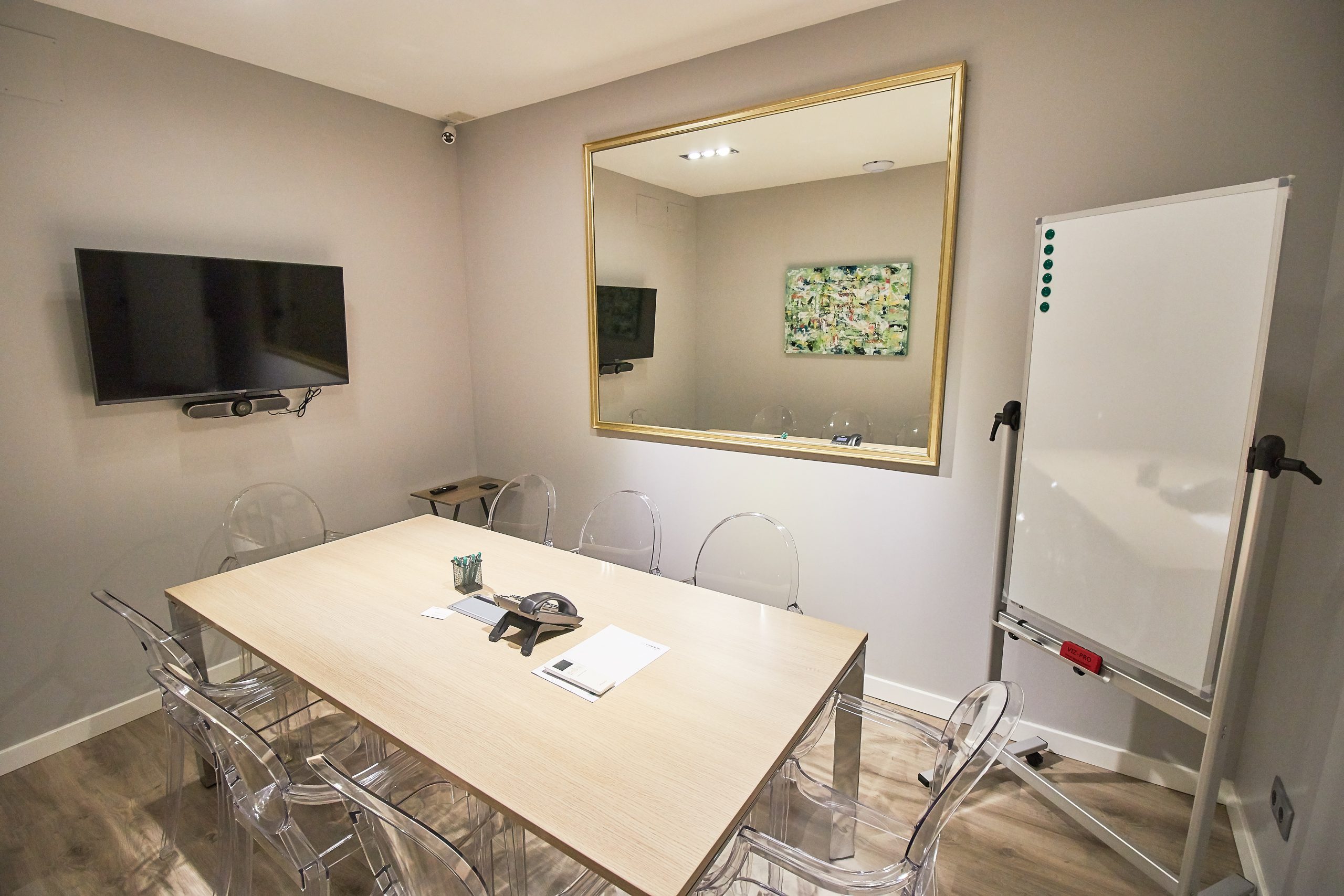
Not every professional needs a permanent office. But they do need a functional space.
The traditional office model is changing. Ten years ago, starting a business meant signing a multi-year office lease, furnishing the office, installing internet, hiring services, and assuming all associated fixed costs. Today, that model makes less and less sense for many professionals.
Consultants who work remotely but need occasional space. Small teams that don't justify a permanent office. Professionals who come to Madrid occasionally and need a professional workspace. Companies in the validation phase that don't want to commit capital to infrastructure.
For all of them, the Office and workspace rental by the hour It offers a flexible alternative that combines professionalism with cost control and zero long-term commitments.
The problem with traditional offices for small businesses
The traditional office rental model presents significant frictions for small businesses or independent professionals.
Long-term contracts that tie up liquidity. Office leases typically require minimum contracts of 3-5 years. For an early-stage company or a professional whose business may change, this represents a financial commitment that limits flexibility and ties up capital.
High initial investment. In addition to the monthly rent, you'll need to pay a deposit (usually 2-3 months' rent), prepare the space, buy furniture, install telecommunications, and set up utilities. Easily €5,000-€10,000 before you can start working.
Fixed costs independent of actual usage. You pay the same whether you work there 5 days a month or 20. If your business is seasonal, has periods of remote work, or you simply don't need the space permanently, you're paying for something you're not using.
Rigidity in the face of change. If your team grows, the space becomes too small, but you're still tied to the contract. If you reduce activity, you continue paying the same. Any change involves renegotiating or breaking contracts, with their associated costs.
For many professionals, the equation doesn't add up. They need professional space, but not permanently. They need flexibility, not years-long commitments. They need to control expenses, not take on high fixed costs.
What are hourly offices and studios?
The concept is simple: rent professional workspace exactly for the time you need it, with no long-term contracts, no initial investments, and no maintenance costs.
It works like a hotel, but for workspaces. You arrive, you work, you leave. You only pay for the hours or days you use it. Everything is provided: furniture, internet, air conditioning, cleaning, and reception (if there is one).
Offices by the hour They usually refer to private enclosed spaces, with capacity for 1-4 people, which you rent when you need privacy, concentration or to receive clients.
Hourly dispatches It is practically synonymous, although it sometimes implies somewhat larger or more formal spaces, designed for liberal professionals (lawyers, consultants, advisors).
ILCOWORKING It's slightly different: you have access to a shared workspace where you work alongside other professionals, with flexible start and end times. Coworking spaces allow you to pay by the hour or day, not just by monthly fees.
Who does this model work for?
Flexible space rental isn't for everyone. It works particularly well for certain professional profiles.
Consultants and advisors who usually work remotely or at the client's home, but occasionally need a professional space for meetings, concentration on complex projects, or simply a change of scenery.
Professionals who come to Madrid sporadically They come from other cities. They need a place to work during their stay, with professional management, and no fixed costs for the rest of the year.
Distributed teams that meet in person on an ad hoc basis. They don't need a permanent office, but when they get together they need adequate space to work collaboratively.
Startups in the validation phase They don't want to commit capital to offices until they have clear traction. They prefer to spend resources on product, marketing, or team.
Professionals who work remotely but need to separate spaces. Working from home is fine, but sometimes you need to get out, concentrate without domestic distractions, or set boundaries between personal and professional life.
Companies that need a temporary presence in Madrid for specific projects, without settling permanently.
Advantages of the flexible model
The appeal of hourly rentals goes beyond simply saving money.
Total cost control. You only pay for what you use. If you work 20 hours there this month, you pay for 20 hours. If you work 5 hours next month, you pay for 5 hours. There are no surprises, no fixed costs to erode your margin.
Zero long-term commitments. There are no long-term contracts. If you change careers tomorrow, move to another city, or simply decide you don't need the space, you're under no obligation.
No initial investment. You arrive and everything is ready. Furniture, technology, services. You don't need to put down a single euro before starting work.
Immediate scalability. If you need more space for a specific project, you simply book a larger office or more hours. If you reduce activity, you reduce usage. There's no friction.
Accessible premium locations. Renting an office in the center of Madrid on a permanent basis can cost €1,500-€3,000/month. Accessing a space in the same location by the hour can cost €200-€400/month depending on actual usage, making it more affordable.
Professional services included. Reception, cleaning, maintenance, security. Everything managed, so you don't have to worry.
Pricing models: what to expect in Madrid
Office and flexible workspace prices in Madrid vary depending on location, size, included services and type of space.
Private offices by the hour:
Small spaces (1-2 people): €15-25/hour. Medium offices (3-4 people): €25-40/hour. Large offices (5-8 people): €40-60/hour.
They typically include: furniture, Wi-Fi, air conditioning, and cleaning. They may or may not include: reception, coffee, and access to a shared meeting room.
Rates for full days:
Many spaces offer full-day rates (8-10 hours) at a discounted rate compared to the hourly rate. An office that costs €20/hour can be offered at €120-€140/day (instead of €160-€200 calculated hourly).
Hourly bonuses:
Buying packages of hours in advance usually includes discounts of 10-20%. For example, a 20-hour package can reduce the unit cost from €20/hour to €16-17/hour.
Memberships with flexible access:
Some centers offer monthly fees that include a certain number of private office hours. For example, €250/month might include access to coworking space plus 10 hours of private office time.
Flexible coworking:
Daily passes: €20-35/day.
Weekly passes: €80-120/week.
Flexible monthly fees: €150-250/month (no fixed position assigned).
The key is to calculate your actual monthly usage and compare different options. If you use an office for more than 40-50 hours a month, a coworking space with a monthly fee plus access to offices is probably more cost-effective than paying for individual hours.
What the price includes (and doesn't include).
It is essential to understand what is included in the rate to avoid surprises.
Usually included:
Basic furnishings: table, chairs, cabinets or shelves. High-speed WiFi connection (100+ Mbps). Climate control (heating/air conditioning). Adequate lighting. Daily cleaning of the space. Access during center hours. Use of common areas (if any): waiting room, coffee area.
Sometimes included, sometimes not:
Professional visitor reception. Coffee, tea, and water. Basic printing. Use of meeting rooms (may incur an additional cost or be included with a time limit). Landline and telephone. Business or postal address.
Generally NOT included:
Storage of materials or files between sessions (unless you rent a locker or cabinet). Sending or receiving mail. Secretarial or administrative support services. Specialized equipment (beyond the basics).
Before signing up, ask exactly what the rate includes to avoid unexpected costs.
Coworking vs private office: when to choose each one
Both options are flexible, but they serve different needs.
Choose coworking (shared space) if:
Your work doesn't require constant privacy. You don't make many confidential calls or long video calls. You value networking and interacting with other professionals. You're looking for the most cost-effective option for your work. Your activity doesn't bother others (you don't need to be constantly on the phone).
Choose a private office if:
You need privacy for client calls, video calls, or meetings. Your work requires absolute concentration without interruptions. You handle confidential information that can't be discussed in public. You receive clients and need a private, professional environment. You prefer to have complete control over your work environment.
Many professionals combine both: they use coworking for regular individual work and reserve a private office occasionally when they receive clients or have important meetings.
Key locations in Madrid for flexible offices
Location is key. Not only for personal convenience, but also for accessibility for customers and connection to services.
Chamberí and Glorieta de Bilbao They combine a central location with a professional atmosphere and excellent connectivity. Metro Bilbao (lines 1 and 4) puts you minutes from anywhere in Madrid. It's a quiet, professional area, without the tourist chaos of the historic center or the premium prices of the Salamanca district.
Paseo de la Castellana and Azca These are traditional corporate areas. Good transport links, a very business-oriented atmosphere, but they tend to be the most expensive options.
Malasaña and Tribunal They attract startups and tech companies. Creative, more informal atmosphere, with bars and cafes nearby.
Atocha and Retiro area It works well if you need a connection with trains (AVE, commuter trains) or you have clients in that area.
The best location depends on your business. If you work with corporate clients, areas like Chamberí or Castellana project a more professional image. If your sector is more creative or tech-oriented, Malasaña might be a better fit. If you travel frequently, proximity to train and bus stations is a priority.
That's what really makes the difference.
Location alone isn't everything. What truly makes the difference isn't just being in Chamberí or Castellana, but the context in which you work every day.
A noisy coworking space with shared tables where different people are present every day does not offer the same professional value as an environment where stable companies, professionals with serious projects, and integrated specialized services coexist.
The difference lies not in the direction on the map, but in what happens within the space.
Here you won't just find coworking tables. You'll find a real professional environment where law firms, consultancies, established companies, and independent professionals working on serious projects coexist. This fosters a level of conversation, networking, and opportunities that is completely different from spaces focused solely on volume.
And something that almost no coworking space can offer: integrated legal and accounting services. When you need tax advice, a quick legal consultation, or help with a contract, you don't have to search for external providers or coordinate schedules. Professionals understand your situation and can answer your questions in minutes.
That is the true value of a well-chosen flexible office: not only where it is located, but what professional context you integrate into.
How it works in practice: the process
Renting an office by the hour is simple, but it's helpful to understand the process.
- Search and compare options. Explore venues in the area you're interested in. Compare prices, included services, opening hours, and user reviews.
- Visit the facilities. Before committing, physically visit the space. Verify that the surroundings, the condition of the facilities, and the services meet your expectations.
- Register as a user. Most centers require prior registration with basic information (ID/Tax ID, contact information, payment method).
- Reserve space. According to the center, reservations can be made online, by phone, or in person. Please specify the date, time, and type of space you require.
- Confirmation and payment. Some centers charge when you book, others at the end of the session. Ask about their policy to avoid surprises.
- Access on the reserved day. You arrive, you identify yourself (some use access cards, others reception), they show you your office and you start working.
- At the end. You leave the space as you found it (usually there's no need to clean, just pick up your things). You confirm the hours used and that's it.
In well-managed professional environments, the entire process is smooth and frictionless.
Temporary offices vs virtual office: they are not the same
It is important to distinguish these concepts because they are often confused.
Virtual office It's a registered address service: you have a professional address, mail reception, maybe call answering, but you DO NOT have access to a physical workspace (or it's very limited, like 2-4 hours a month).
Temporary/Hourly Office It's just the opposite: you have real access to physical workspace when you need it, but it doesn't necessarily include permanent address or administrative services.
Many professionals combine both: a virtual office to have a professional address in Madrid (€75-95/month) + occasional office rental when they need to work in person or receive clients.
This combination is usually cheaper and more flexible than renting a traditional office.
ILCOWORKING: real flexibility in the heart of Madrid
In ILCOWORKING, Located at Glorieta de Bilbao nº 1 (28004 Madrid), the model is designed precisely for professionals who need flexibility without sacrificing professional services.
Available options:
Flexible coworking from €295/month with daily access and no fixed schedule. Private offices from €40/day when you need a private space. Meeting rooms from €20/hour for client meetings. Virtual office from €75/month if you only need a business address.
But beyond the spaces themselves, what truly sets them apart is the context. ILCOWORKING & Legal Services is more than just a rental space. It's an environment where professionals, businesses, and integrated legal services coexist. If you need legal, accounting or tax advice, is available in-house.
The location, just a 1-minute walk from the Bilbao metro station (lines 1 and 4), makes it easily accessible from anywhere in Madrid. Extended hours (8:30 a.m. to 8:30 p.m., Monday to Friday) give you the flexibility to schedule work without rigid limitations.
Booking is quick and easy, with no red tape. You contact them, confirm availability, and book. The price they quote is the price you pay, with equipment included and no last-minute surprises.
Calculate if it's worth it for you: do the math
Before deciding, calculate your actual expected usage.
Example 1: Consultant who needs space 2 days/week
8 days a month × €30/day = €240/month. Alternative: Monthly coworking €295/month (includes all days + meeting rooms). In this case, coworking is more cost-effective because it adds value (daily access) for a small incremental cost.
Example 2: Professional from another city who comes 4 days a month
4 days × €30/day = €120/month. More cost-effective than a virtual office (no business address required) or monthly coworking (I wouldn't use daily access).
Example 3: Team that needs to meet in person once a month
Meeting room 4 hours × €30/hour = €120/month. More efficient than maintaining a fixed office or individual offices.
The key is to be honest about your actual usage, not what you'd like to use it for. Many professionals overestimate how much they'll use a space and end up paying for something they don't take advantage of.
Conclusion: pay for what you use, not for what you could use
The traditional model of fixed offices with long-term contracts makes less and less sense for independent professionals, small teams, or early-stage companies.
He Office and workspace rental by the hour It offers a flexible alternative that combines professionalism with cost control. You only pay for the time you actually work there, with no commitments, no upfront investment, and no hassle.
It's not for everyone. If you need an office 5 days a week, 8 hours a day, a traditional rental (or coworking with a monthly fee) is probably more efficient. But if your work is variable, if you usually work remotely but need space occasionally, or if you simply want total flexibility, this model gives you exactly what you need.
Evaluate your actual usage, compare options based on location and services, and make your decision based on concrete numbers, not perceptions.
Professionalism doesn't mean fixed costs. It means having access to what you need when you need it.
ILCOWORKING – Glorieta de Bilbao, 1 – 28004 Madrid (Chamberí)
Contact:
Telephone: +34 91 117 94 82 | +34 900 264 918
Email: info@ilcoworking.es
Schedule:
Monday to Friday: 8:00 – 20:30
Services:
- Flexible coworking from €295/month
- Private offices from €40/day
- Meeting rooms from €20/hour
- Virtual office from €75/month
- Legal services. Special rate for Il Coworking members.
Do you need flexible workspace without compromises?
Contact and we'll explain the options that best suit your way of working.

